 By Bemi Brooks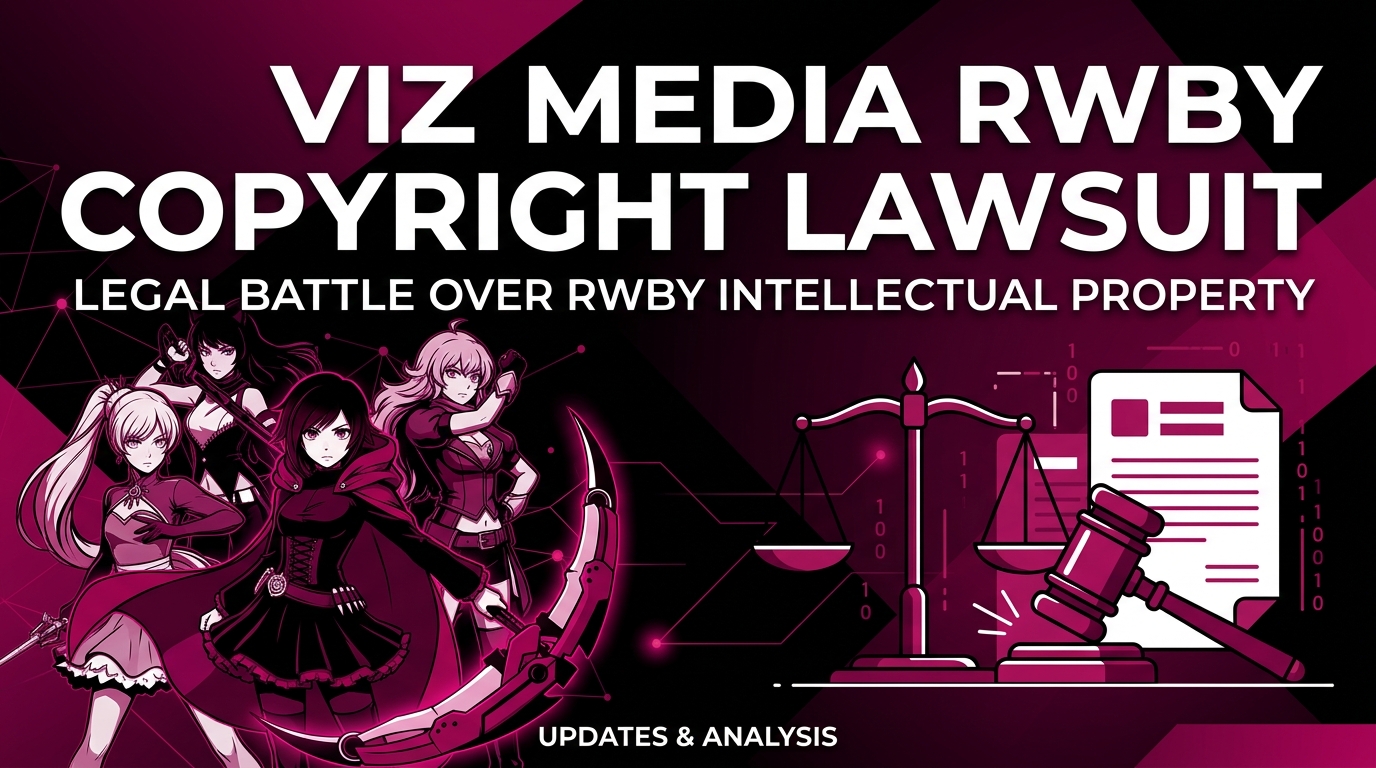
The VIZ Media RWBY Copyright Lawsuit has drawn attention from legal observers, entertainment industry professionals, and intellectual property (IP) stakeholders. Filed in late 2024 in the United States District Court for the Northern District of Illinois, the case involves VIZ Media, LLC, enforcing its rights in the RWBY franchise against numerous online sellers accused of widespread copyright and trademark infringement through counterfeit merchandise.
While the litigation follows a familiar pattern of mass enforcement actions against e-commerce counterfeiters, it occurs shortly after VIZ Media’s acquisition of the RWBY intellectual property. This timing highlights evolving challenges in IP ownership transfers, particularly for popular animated series moving between production companies in a global digital marketplace. The case underscores how new owners must actively protect acquired assets to preserve value, while also illuminating procedural tools available under federal law for combating anonymous online infringement.
This article examines the facts of the VIZ Media RWBY Copyright Lawsuit, the governing legal principles, the court’s rulings, and the broader implications for IP ownership in the entertainment sector. All information is drawn from publicly available court records and official announcements. This article is for informational purposes only and does not constitute legal advice.
Background on the RWBY Franchise and VIZ Media’s Role
RWBY is an anime-inspired animated web series that debuted in 2013. Created by the late Monty Oum and initially produced by Rooster Teeth Productions, the series follows Team RWBY (Ruby Rose, Weiss Schnee, Blake Belladonna, and Yang Xiao Long) in a world threatened by monstrous creatures known as Grimm. It has expanded across nine volumes (totaling 117 episodes), manga adaptations, video games, merchandise, and spinoffs including the 2022 anime series RWBY: Ice Queendom produced by studio SHAFT.
Rooster Teeth produced the series through 2023. Following the company’s shutdown in 2024 under parent Warner Bros. Discovery, the RWBY intellectual property rights were placed for sale. On July 5, 2024, VIZ Media announced its acquisition of RWBY. The deal transferred rights for future distribution, production, licensing, and consumer products.
VIZ Media, a leading publisher of Japanese manga and anime content in North America, had already partnered with Rooster Teeth since 2016 on RWBY-related print projects, including multiple manga volumes and the compendium The World of RWBY. The acquisition positioned RWBY within VIZ Media’s portfolio of groundbreaking animated properties, with statements from executives emphasizing plans to expand the universe and reach new audiences. RWBY Showrunner and Co-Creator Kerry Shawcross noted VIZ’s longstanding commitment to the franchise, while VIZ Media’s Senior Vice President of Animation Brian Ige highlighted the series’ distinctive style and global resonance.
The transfer of ownership from Rooster Teeth to VIZ Media exemplifies common practices in media M&A transactions. Acquirers receive registered trademarks and copyrights, along with associated goodwill. Federal registration provides nationwide protection and presumptive validity in infringement suits. In this instance, VIZ Media holds U.S. Trademark Registration No. 4542478 for RWBY marks and multiple Copyright Office registrations covering the animated episodes, characters, and related works.
Filing of the VIZ Media RWBY Copyright Lawsuit
On December 6, 2024, VIZ Media, LLC filed suit in the United States District Court for the Northern District of Illinois (Eastern Division) under Case No. 1:24-cv-12581. The complaint named as defendants “The Partnerships and Unincorporated Associations Identified on Schedule A.” This format, often called a “Schedule A” or “John Doe” complaint, is a recognized procedural tool in federal courts for cases involving large numbers of anonymous or pseudonymous online infringers who conceal their identities through seller aliases on e-commerce platforms.
Defendants were described as individuals and entities operating interactive online stores, primarily believed to be based in the People’s Republic of China or other jurisdictions. They allegedly used seller aliases on major marketplaces to sell unauthorized RWBY merchandise featuring exact copies or close imitations of the protected characters, logos, and artwork. The complaint detailed coordinated tactics, including shared website templates, payment processors, and search-engine optimization practices designed to mimic official products and confuse consumers.
VIZ Media asserted four counts:
- Trademark infringement and counterfeiting under 15 U.S.C. § 1114 (Lanham Act).
- Copyright infringement under 17 U.S.C. §§ 106 and 501.
- False designation of origin under 15 U.S.C. § 1125(a) (Lanham Act).
- Violations of the Illinois Uniform Deceptive Trade Practices Act (815 ILCS 510, et seq.).
The allegations emphasized willful conduct: defendants knowingly reproduced protected works and marks without authorization, sold goods at below-market prices, and caused consumer confusion regarding origin, sponsorship, or approval. VIZ Media claimed irreparable harm including dilution of brand goodwill, lost sales through authorized channels, and loss of control over product quality.
The suit requested statutory damages, actual damages (or defendants’ profits), treble damages where applicable, attorneys’ fees, costs, and broad injunctive relief. It also sought orders directing third-party service providers (such as e-commerce platforms and payment processors) to disable listings, freeze assets, and transfer funds.
Court Proceedings and Default Judgments
Many defendants failed to appear or respond to the complaint, a common outcome in Schedule A cases where overseas sellers may lack U.S. counsel or incentive to litigate. Federal Rule of Civil Procedure 55 permits entry of default judgment in such circumstances when properly noticed and supported by evidence.
On February 25, 2025, District Judge Lindsay C. Jenkins issued orders granting default judgment against 131 remaining defendants (after earlier dismissals of approximately 44 others). The court found the allegations well-pleaded and supported by evidence of willful infringement.
The February 2025 Ruling: Damages and Injunctive Relief
The ruling awarded substantial statutory damages. For each defendant, the court imposed $100,000 for willful trademark counterfeiting and $100,000 for willful copyright infringement, totaling $200,000 per defendant. With 131 defendants, the potential recovery reached up to $26,200,000. These amounts fall within the statutory ranges: up to $2,000,000 per counterfeit mark under 15 U.S.C. § 1117 for willful trademark violations, and up to $150,000 per infringed work under 17 U.S.C. § 504 for willful copyright violations. Courts select amounts based on factors including the willfulness of the conduct, scale of operations, and need for deterrence.
Beyond monetary relief, the order provided comprehensive equitable remedies:
- Permanent injunction prohibiting further use of RWBY IP in connection with unauthorized goods.
- Directives to e-commerce platforms to shut down or transfer seller accounts and domain names to VIZ Media’s control.
- Orders to payment processors (including PayPal, Alibaba, AliPay, Wish.com, Amazon Pay, and others) to freeze assets within seven days and transfer funds to VIZ Media within 14 days, up to the amounts of proven infringement.
- Requirements for defendants to deliver up and destroy infringing materials.
VIZ Media has publicly indicated plans to pursue additional similar actions to address ongoing counterfeiting.
Legal Principles Underlying the VIZ Media RWBY Copyright Lawsuit
U.S. copyright law (Title 17 of the U.S. Code) grants creators and owners exclusive rights to reproduce, distribute, display, and create derivative works. Registration with the U.S. Copyright Office is a prerequisite for suing in federal court and enables statutory damages and attorneys’ fees. Statutory damages serve dual purposes: compensating the owner for unquantifiable losses and deterring future violations, especially where actual damages or profits are difficult to prove due to defendants’ anonymity.
Trademark law under the Lanham Act (15 U.S.C. §§ 1051 et seq.) protects distinctive marks used in commerce. Federal registration creates a presumption of validity and exclusive rights. Counterfeiting (exact or substantially indistinguishable copies) triggers enhanced remedies, including mandatory treble damages or profits and statutory damages in willful cases. False designation of origin addresses actions likely to cause consumer confusion about source or affiliation.
Illinois state law supplements federal claims by prohibiting deceptive trade practices that create likelihood of confusion.
Schedule A complaints address practical challenges in modern IP enforcement. E-commerce has globalized counterfeiting, making traditional service of process difficult. Courts in the Northern District of Illinois and other venues have approved this approach when plaintiffs demonstrate a logical connection among defendants (e.g., shared operational templates) and when due process is satisfied through notice via the platforms themselves.
Default judgments rest on the principle that properly served defendants who choose not to defend forfeit their right to contest the claims. However, courts still require plaintiffs to establish liability through evidence, often via declarations detailing the infringing activity.
Implications for IP Ownership in the Entertainment Industry
The VIZ Media RWBY Copyright Lawsuit illustrates several practical realities facing IP owners after acquisitions. When rights transfer, the new owner steps into the shoes of the predecessor, gaining the benefit of existing registrations while assuming responsibility for enforcement. Active protection signals to the market that the IP remains valuable and is not abandoned, which can strengthen claims in future disputes and support licensing negotiations.
For web-based animated series like RWBY, which originated outside traditional studio pipelines, ownership transitions can introduce questions about chain of title, residual rights, and international recognition of U.S. registrations. While this case did not involve contested ownership between VIZ Media and another major entity, it publicly affirms VIZ Media’s control and deters potential challenges by demonstrating willingness to litigate.
The case also highlights enforcement challenges in the digital economy. Counterfeit merchandise undermines authorized licensing revenue streams critical to funding new production. For fans, unauthorized goods may pose quality or safety risks and dilute the brand experience. For online marketplaces, the remedies underscore growing expectations that platforms cooperate with rights holders to remove infringing listings promptly.
Broader industry trends show similar actions by other entertainment companies against counterfeiters of popular anime, manga, and gaming properties. Statutory damages provide an efficient mechanism when tracing actual sales is impractical, though collection against foreign defendants can present logistical hurdles requiring further proceedings in their home jurisdictions or through international treaties.
Effects on Stakeholders
IP Owners and Acquirers: The ruling demonstrates that timely, aggressive enforcement can yield significant remedies even without protracted trials. It encourages due diligence in acquisitions to confirm clean title and registered protections.
Consumers and Fan Communities: Authorized merchandise supports creators and ensures quality. The lawsuit does not target good-faith fan creations or non-commercial uses that might qualify as fair use, but it addresses commercial counterfeiting that competes directly with licensed products.
E-Commerce Sellers and Platforms: The outcome serves as a reminder of liability risks for selling unauthorized goods. Platforms face pressure to implement stronger monitoring and takedown systems.
Legal and Compliance Professionals: The case reinforces the utility of federal statutory remedies and equitable relief in IP strategy. It also highlights the importance of venue selection in districts experienced with these matters.
Future Outlook
VIZ Media has indicated ongoing efforts to expand RWBY through new chapters while simultaneously addressing infringement. Additional lawsuits referenced in public reporting suggest a sustained enforcement campaign. As the franchise evolves under new ownership, continued vigilance will likely remain central to its commercial success.
Legal developments in this area may influence how courts balance robust IP protection with due process for alleged infringers, particularly in cross-border contexts. Legislative or regulatory attention to online counterfeiting could further shape available tools.
In summary, the VIZ Media RWBY Copyright Lawsuit provides a clear example of federal courts applying established copyright and trademark frameworks to contemporary digital infringement. By securing a substantial judgment and injunctive relief shortly after acquiring the property, VIZ Media has reinforced its ownership position and highlighted the mechanisms available to protect valuable entertainment IP in an increasingly interconnected marketplace. Stakeholders monitoring IP developments will continue to watch how such cases shape ownership strategies, enforcement practices, and the balance between innovation and protection in the entertainment industry.
You May Also Like: Dallas County Judge Pay Lawsuit and the Future of Judicial Compensation